
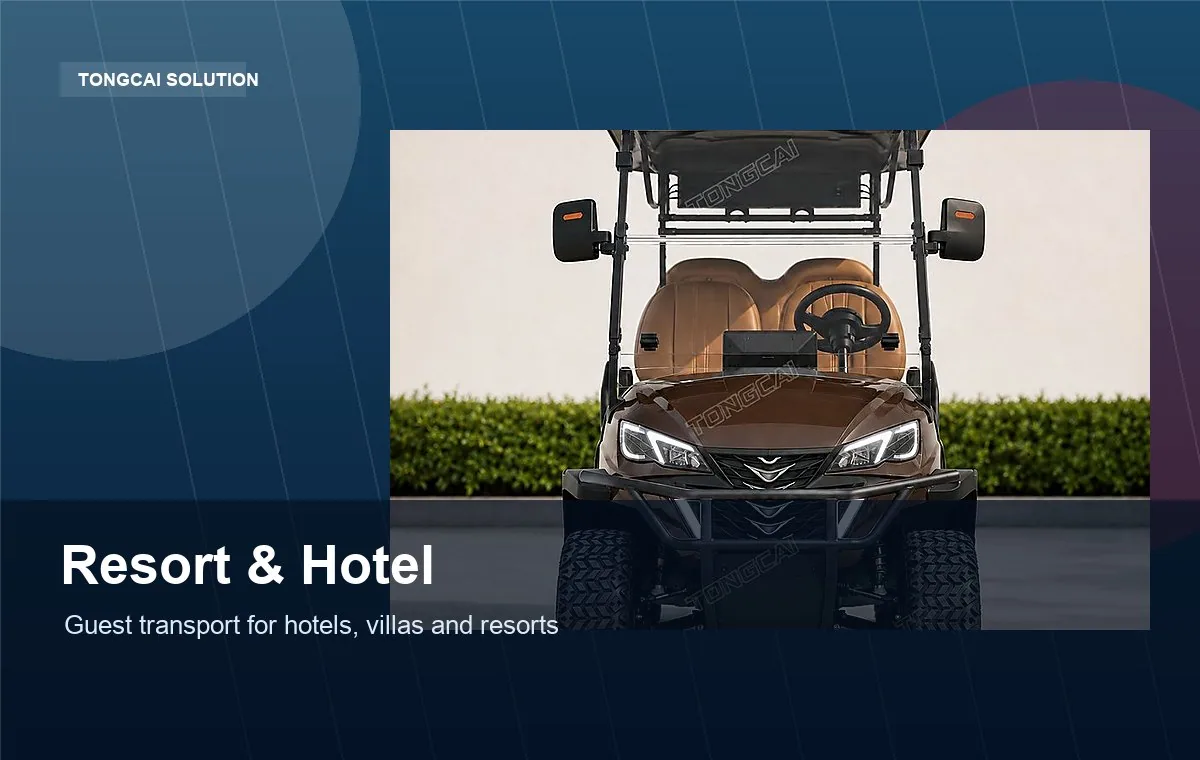
Published 2026-09-21 · Evergreen procurement guide · Company-specific terms require written confirmation
1. Separate the Fleet Jobs
A single resort may move arriving guests, luggage, housekeeping teams, food and beverage supplies, security staff and maintenance equipment. Combining all of these into one generic “golf cart” requirement makes the quotation difficult to compare and can leave the fleet short of passenger capacity or cargo space.
List each job as a separate operating profile. For every profile, record who or what moves, pickup and drop-off points, trip frequency, service hours and any guest-experience requirement. A passenger shuttle may prioritize entry, seating and weather protection; a luggage or maintenance cart may need a defined cargo layout and load basis. Use the application overview to separate passenger, rental and utility use before discussing models.
| Fleet job | Inputs to record | Decision affected |
|---|---|---|
| Guest transfer | Passengers per trip, stops, wait-time target, accessibility needs | Seat layout, entry, handholds, weather protection |
| Luggage movement | Bag count and size, passenger mix, loading method | Passenger/cargo balance and storage layout |
| Staff transport | Team size, shift changes, restricted routes | Capacity, access control and dispatch plan |
| Housekeeping or maintenance | Tools, linen, waste or supplies; largest item and weight | Cargo bed or box, tie-down and route suitability |
| Events and peaks | Arrival waves, functions, seasonal occupancy and contingency demand | Peak fleet size and standby plan |
2. Survey Every Route and Peak Period
Walk or drive the actual routes. Record distance, steepest sustained grade, short ramps, surface, narrow points, turning space, pedestrian crossings, speed controls, drainage, low-clearance areas and permitted parking. Mark where carts can pass, turn, wait and charge without blocking guests or service traffic.
Demand changes by time. A morning staff route and an evening guest shuttle may use the same cart, but only if dispatch, cleaning and charging windows fit. Build a simple table by 30- or 60-minute block showing requested trips, passengers or loads, trip time and the maximum number of carts needed at once. Add time for loading, guest assistance, cleaning and repositioning.
Do not calculate fleet size from room count alone. The quantity should follow simultaneous demand, acceptable wait time, charging and maintenance availability. Keep the assumptions with the calculation so they can be tested during a pilot.
3. Plan Passengers, Luggage and Access Together
Nominal seat count does not describe a real hotel trip. A four-seat trip with large bags can need a different layout from a four-seat internal shuttle. Record the typical and worst planned mix of adults, children, luggage, mobility equipment and staff items. Ask where each item will be placed and restrained without obstructing entry, exits, driver visibility or controls.
Compare relevant 4-seat and 6-seat cart categories, and use an electric cargo utility cart for jobs that should not share passenger space. Ask the supplier to document dimensions, rated capacities, seating orientation, step-in height, handholds, roof and weather-protection options for the proposed configuration.
Where guests may have reduced mobility, involve the resort's accessibility and safety teams. Define boarding assistance, mobility-device handling, path suitability and local accessibility requirements before the order. A supplier proposal cannot replace the operator's site-specific assessment.
4. Match the Duty Cycle, Battery and Charging Plan
Battery choice should follow the complete duty cycle. Record route distance, trips per shift, passenger or cargo load, grades, surface, temperature, operating hours, planned breaks and the minimum reserve the operator expects. Then ask for the assumptions behind any proposed operating-time or range estimate. Do not compare an unqualified range number across different vehicles and test conditions.
Map destination power, charger location, electrical capacity, ventilation and weather protection. Decide who connects and inspects chargers, how cables are protected from guests and vehicles, and how charging is scheduled around shifts. The site electrical design and installation should be reviewed by qualified local professionals.
Use the lithium versus lead-acid guide to compare maintenance and charging tradeoffs, and the 48V versus 72V guide to understand why voltage must be evaluated as part of a matched vehicle system. Ask for the final battery, charger, controller and motor configuration in writing.
5. Record Terrain, Climate and Operating Controls
Coastal air, rain, heat, cold, dust, irrigation, steep paths and uneven surfaces change the operating brief. Tell suppliers which conditions are normal and which are occasional. Ask how the proposed tires, brakes, ground clearance, body protection, seating material and electrical components are matched to those conditions, and request the limitations in writing.
Define the operator's controls before delivery: authorized drivers, route restrictions, passenger limits, speed rules, key management, parking, charging, pre-use checks, incident reporting and weather shutdown criteria. Confirm local rules for where and how the carts may operate. Requirements vary by jurisdiction and site; a factory specification does not grant road or public-path permission.
Accessories should solve a documented need
- Weather protection should match rain, sun and wind exposure without impairing visibility.
- Lighting, mirrors, warning devices and markings should follow the site's risk assessment and local rules.
- Seat belts, doors, handholds and boarding aids should be evaluated for the route and passengers.
- Branding and premium finishes should be approved after operational and safety needs are fixed.
- Tracking, radios or dispatch equipment should fit the resort's actual fleet process and privacy policy.
The OEM customization checklist helps keep appearance choices, operating requirements and the approved specification on the same revision.
6. Build the Maintenance and Spare-Parts Plan Before Ordering
Ask who performs daily checks, planned maintenance, diagnostics, warranty communication and repairs. Record local technician capability, expected response process, service documentation language and the tools available on site. A long warranty statement is not a substitute for a working service process.
Request a model- and revision-specific recommended parts list. It should distinguish routine consumables, wear items, critical downtime parts and optional stock. Confirm part identification, ordering channel, supersession process, packaging, dispatch responsibility and technical escalation. Do not accept a generic parts list that cannot be tied to the delivered vehicles.
Require operator and maintenance manuals, wiring information and fault-report fields appropriate to the agreed service scope. Review the after-delivery problem guide for a structured evidence process if a vehicle, battery, charger, transport or setup issue occurs.
7. Pilot, Inspect and Accept Against the Same Brief
For a new route or unfamiliar configuration, define a site pilot or equivalent evidence before committing the full fleet when practical. Use representative passengers or loads, realistic grades and surfaces, peak trip timing and the planned charging window. Record the route, load, weather, state of charge, stops and any exception so the result can be interpreted.
Turn the final brief into an acceptance checklist. Match model and configuration revisions, labels, accessories, chargers, manuals, spare parts and packing documents. Agree on functional checks and route-specific items before shipment. The quality-control guide explains how buyers can define inspection evidence, while the container loading checklist connects the approved configuration to packing, securing and destination unloading.
At delivery, separate transport damage, missing items, assembly or setup issues and product faults. Photograph and record exceptions before altering affected items when safe, and follow the written notification process.
Copyable Resort & Hotel Fleet RFQ Brief
- ☐ Property type, country and operating location
- ☐ Fleet jobs: guests, luggage, staff, housekeeping, maintenance or events
- ☐ Quantity estimate and required in-service date
- ☐ Route map, distance, grades, surfaces, clearances and turning limits
- ☐ Passengers, luggage or cargo per trip, including peak condition
- ☐ Trips or operating hours per shift and acceptable guest wait time
- ☐ Charging windows, destination power and charger location constraints
- ☐ Temperature, rain, coastal air, dust and storage conditions
- ☐ Accessibility, boarding, weather-protection and operator-control needs
- ☐ Required local compliance evidence and permitted operating area
- ☐ Branding and accessories, separated into required and optional items
- ☐ Maintenance capability, manuals, diagnostics and spare-parts expectations
- ☐ Inspection, pilot, packing, unloading and acceptance requirements
- ☐ Destination, delivery point and import-party responsibilities
Send this brief with the proposed model mix so a supplier can state assumptions and exclusions. For a TONGCAI configuration discussion, use the inquiry form or build a cart. Final performance, availability, documentation, price and delivery terms must be confirmed in the written quotation and contract.